We welcome you to the TRRU. Local and global practices of science, technology and medicine have targeted our bodies, producing sites of compromise, categorization and contestation. We are promised the benefits of biotechnologies while simultaneously exposed to their associated risks (environmental decline, chronic illness, new viruses, super bacteria, tissue markets). Supported by publicly funded and corporate-driven industrial research agendas, these technologies create new ways of representing scientific and cultural facts. Who and what drives these ventures and values and how can we best come to understand them? read more


==========================================================

Canadian Anthropology Society / Société canadienne anthropologie

Professor Janice Graham has been elected President of the Canadian Anthropology Society/Société canadienne anthropologie. At the annual meetings in Montreal May 31-June 3, she has organized and is chairing a CASCA-CIHR-SSHRC Roundtable forum on the new funding initiatives for health research in Canada. She has also organized and is chairing a session on The Anthropology of Vaccines with her postdoctoral fellows Farah Huzair, Amrita Mishra, Alex Borda-Rodriguez and Marylene Dugas, which presents preliminary findings from the CIHR grant "Regulatory challenges to the development of new vaccines: Mapping emergent relations between science, evidence and policy."

 =============================================================


Contesting Aging & Loss, a new book


Dr. Janice Graham and Dr. Peter Stephenson are the co-editors of the new book Contesting Aging and Loss, published in April 2010 by the University of Toronto Press.  This work takes a look at ways in which the idea that older adults are necessarily in decline causes problems in itself.


The dominant biomedical paradigm of loss has seeped into too common a practice of engaging elders on terms that are not their own. Instead, Contesting Aging & Loss approaches aging from the viewpoint of those growing old. The contributors to this book take seriously the proposition that aging is complex and multifaceted and encompasses many experiences including those that entail a deep sense of loss. But so too, they discover people who are continuing to encounter fulfilments, gains, struggles and resistances. 
 
The voices heard here contest the dominant paradigm of disease, decline and dementia, and the idea that much of what we experience as we age is simply “inevitable”, a perspective that robs us all of power, agency, and the ability to determine and live fulfilled lives –– whether we are engaged in the study of aging, or are simply growing old. As such, the book is meant as a corrective based on ethnographic evidence. Drawing from South Africa, the Netherlands, Australia and Canada, the stories presented here speak to a dubious connection of the aging and loss paradigm with another dominant paradigm: a free market economic one that ignores the determinants of unequal power, resources, and income.
 
These stories provide a rich conceptual and empirical resource for a seniors-centred approach to living and continuing to grow from those whose lives in many parts of the world reflect a richness that is generally lost in more prosaic studies of aging which depend on statistical information and which often paint an overly simplistic image of despair as numbers dwindle and graphs arc ever downward.
 
"Contesting Aging & Loss is a superb example of critical gerontology,” says Dr. Keating, Chair of the International Association of Gerontology and Geriatrics.
 

Contesting Aging & Loss provides a richness of thought for the experienced policy-maker, academic, and the up-and-coming student concerned with the challenging concepts of loss and aging,” says JF Kozak, Providence Health Care, Vancouver.


For more information, or to purchase a copy, please visit: http://www.utppublishing.com/product.php?productid=2662&cat=0&page=1 


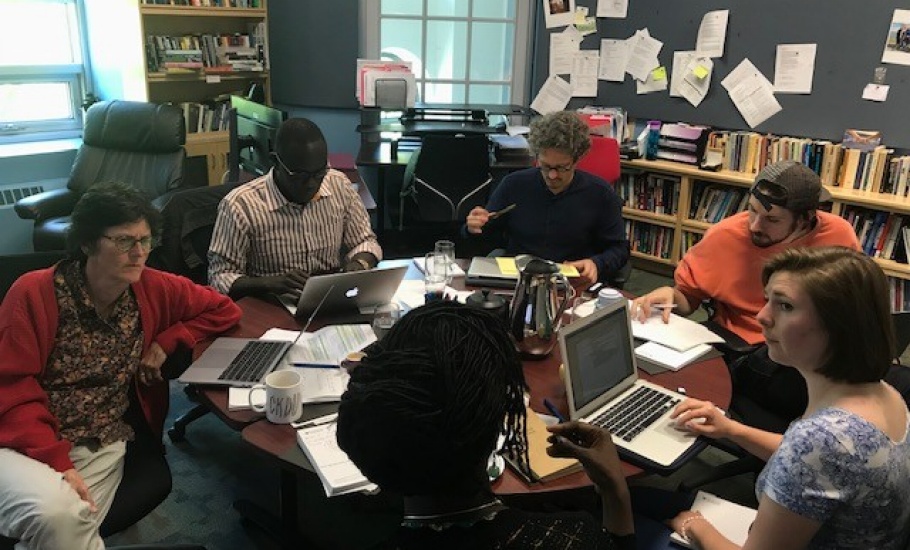
TRRU is an interdisciplinary team of  researchers led by medical anthropologist and Canada Research Chair, Professor Janice Graham. We draw from anthropology, sociology, biomedicine and political science to study configurations of technoscience and risk. 

Our research group at Dalhousie University in Halifax uses a science and technology studies conceptual framework and multi-sited ethnographic methodological approach to understand how scientific and cultural facts emerge. While our primary research site is Canada, our members have conducted research in Burkina Faso, Colombia and the United Kingdom.


Technoscience and Regulation Research Unit

Dalhousie University

5849 University Avenue

CRC Room 315

Halifax, Nova Scotia
Canada

B3H 4H7

phone: 902.494.6733
fax:     902.494.3865

email:   trru@dal.ca